EXPERIMENT 02 / CHANGE THE RULES
Take control of Venus.
This is a what-if model. Change the rotation and see when the Sun returns. The year stays fixed at 225 Earth days.
116.8EARTH DAYS / NOON TO NOON
Backward rotation brings the next noon sooner.
 ONE COSMIC THINGOBSERVATORYOBSERVATORY 01
STAY CURIOUS.
Pick something. Land it, take it apart, or figure it out.
0 discoveries saved on this device
Separate seven exterior sections of NASA’s actual model. Isolate a piece, go closer, put it back together.
Open the 3D collection ↗ INSIDE THE SPACECRAFTLook around Smithsonian’s scan of the Apollo 11 cabin. Remove seats and the shell to inspect the layout.
Try it 02 / FLY IT YOURSELFLand on the Moon. Three approaches, limited fuel, and absolutely no air brakes.
Try it 03 / PLANET HUNTERFind the repeating dip. Work out its orbit and size. Then try a new signal.
Try it 04 / EIGHT QUESTIONSSpace has a habit of making the obvious answer wrong. Every answer comes with the explanation.
Try it 05 / MAKE A MESSLaunch stars and planets into a system. Watch the encounters, collisions and escape paths.
Open the gravity playground ↗ 06 / SIX DECISIONSYour probe has limited power. Collect, cool and transmit before contact ends.
Take command ↗ 07 / FROM THE ARCHIVESNuclear pulse propulsion, lunar freight tracks, liquid telescopes, ocean robots, and more.
Read the mission dossiers ↗ 08 / FOLLOW THE EVIDENCEA flag on the Moon. A face on Mars. Read what the evidence can actually tell us.
Examine the claims ↗ 09 / THE HORIZON ROOMExplore the light-bending illustration and compare clock rates outside a black hole.
Enter the horizon room ↗ 10 / PICK YOUR WINNERChoose a planet and race orbital periods. New lineups change the comparison.
Start an orbit race ↗ 11 / TEN YEARS OF SCIENCERation a probe’s dwindling power. Choose the instruments worth keeping alive.
Manage the power budget ↗ 12 / THE VENUS CASEPredict which clock finishes first, then follow a spot on Venus to the next noon.
Try the Venus case ↗LUNAR LANDING / FLIGHT CHALLENGE
Touch down on the green pad. Keep vertical speed below 3 m/s and sideways speed below 2 m/s.
Hold the buttons or use the arrow keys. Let go to stop firing; momentum continues. UP opposes the fall. Leaving this activity pauses the flight.
Gravity is 1.62 m/s², approximately the Moon’s surface gravity. There is no atmospheric drag. Steering, fuel use, vehicle size and landing limits are game rules. The vehicle stays upright; this is a flight diagram, not a replica of an Apollo landing.
NASA: lunar gravityPLANET HUNTER / CASE 1
A planet passing in front of a star blocks a little light. Find the repeating dips, then estimate the orbit and size.
First-choice candidates: 0/0
These are synthetic training signals, not telescope observations. Every chart shows 15 days; vertical depth is normalized for visibility. A repeating dip is a candidate, not proof of a planet. Stellar variability, eclipsing binaries and instrument effects require follow-up checks.
For a fully overlapping transit of a uniformly bright star, fractional depth is approximately the square of the planet-to-star radius ratio. Real analysis also accounts for limb darkening and other effects.
NASA: transit mathematics (PDF)THE SPACE CHECK / 1/8
Correct: 0
One Cosmic Thing makes space stories and activities for curious people. The Observatory is the place to go further: inspect hardware, try a physical model, or follow a surprising idea back to its source.
Articles distinguish proposals from flown missions. Games identify their invented rules. Images and models retain agency and creator credits. If something seems wrong, use the channel’s comments to point us to the claim and its source.
Visit One Cosmic Thing on YouTube
Quiz results and completed challenges can be saved in this browser’s local storage. They are not uploaded by the Observatory’s application code. Clear them from the activity directory or your browser settings. This version has no advertising tags or audience analytics.
The hosting platform separately handles site access and may process connection information or use its own cookies. Following a source or channel link takes you to that service and its privacy practices. Any future advertising setup will require updated disclosures and appropriate consent controls before ad tags are enabled.
ONE COSMIC THING / OBSERVATORY
Bend an orbit. Dissect a spacecraft. Open the files on the missions that never flew.
Enter the gravity labTHE HORIZON ROOM / IMMERSIVE EXPERIMENT
Enter a place where light bends and two clocks stop agreeing.
THE GRAVITY PLAYGROUND / MANY BODIES. NO SCRIPT.
Drag across the field to launch a body. A longer arrow means more speed. Every body pulls on every other body.
Start with binary stars. Add a light tracer near the pair and see whether it stays, escapes, or collides. Undo, change its launch speed, and compare.
Or start an unstable trio. Add a heavy body and watch the center of mass shift.
Newtonian gravity in two dimensions with normalized G = 1. A velocity-Verlet integrator and small softening length handle close encounters. Merge collisions conserve mass and linear momentum, not kinetic energy. Body sizes are exaggerated. This is an exploration tool, not mission software.
NASA: gravity and mechanicsTHE COLLECTION / EXPLORE THE HARDWARE
Explore the real cabin scan. Drag to look around inside, or remove surfaces to see the layout.
Smithsonian scan of the Apollo 11 command module. Visible cockpit surfaces, not equipment inside sealed walls.
GO CLOSER
Drag to orbit. Pinch or scroll to approach. Double-click the model to focus on that exact point.
FIELD NOTES
Seven exterior sections. Select one to inspect it.
Illustrative separation of NASA’s exterior model. These are visual regions, not an internal cutaway or assembly instructions.
03 / THE MISSIONS THAT DIDN’T FLY
Real proposals, real engineering problems. A concept study is not proof that a machine was built.
Project Orion
Open dossier +Project Orion studied a propulsion idea that put the energy source outside the vehicle. Repeated nuclear pulses behind a pusher plate would transfer momentum to the spacecraft, with shock absorbers between the plate and the rest of the vehicle.
That is very different from heating propellant inside a reactor. It was also very different from today’s Orion crew capsule, which shares the name but not the propulsion concept.
The archival paper follows the concept and its engineering difficulties. It does not document an operational nuclear-pulse spacecraft. Treat impressive performance estimates as estimates attached to a proposed system.
Read the NASA-hosted technical paper (PDF) ↗NERVA
Open dossier +NERVA was a joint NASA and Atomic Energy Commission program to develop a nuclear rocket. Its reactor would heat propellant, which could then expand through a nozzle to produce thrust.
The program considered applications including long-range missions and upper stages. Hardware was tested on the ground, but funding declined in the late 1960s. The program ended in 1973 before an engine flight test.
The distinction matters: this was more than a drawing, but it never became a flown engine. Explore the engine model above to trace the conceptual route from propellant supply through the heated core to the nozzle.
Read NASA’s test-program history ↗Zephyr landsailing rover
Open dossier +A rover on Venus has to survive a surface hot enough to defeat ordinary electronics. Zephyr explored another unusual requirement: moving across the ground using a sail.
The NASA Innovative Advanced Concepts study examined a wind-driven vehicle and electronics able to work in extreme heat. The sail is for travel across the surface, not for flight through the atmosphere.
This is an example of mission design shaped by its environment. The hostile atmosphere becomes part of the proposed mobility system. The final report is a feasibility study, not a record of a rover operating on Venus.
Open the NIAC final report ↗04 / FOR THE SKEPTICS
A strange-looking picture is a starting point. Open a claim, inspect the explanation, then read the source yourself.
What looks strange: The flag is extended and wrinkled despite the Moon having no appreciable atmosphere.
What the hardware explains: A horizontal rod supported the top of the flag. During Apollo 11’s deployment it did not extend fully, leaving folds in the fabric. A still image of those folds does not establish that wind was blowing.
Verdict: The visible shape is consistent with the support mechanism. This particular claim does not provide evidence of a staged landing.
Read the deployment account ↗What looks strange: In a low-resolution image, a landform can resemble a face.
What changed: Mars Global Surveyor photographed the feature at much higher resolution in 1998 and again in 2001. Those observations let viewers inspect surface structure that the earlier imagery could not resolve.
Verdict: A resemblance in one image is not sufficient evidence of construction. Compare the higher-resolution observations before treating the apparent face as an artifact.
Inspect the 1998 observation ↗PLAY A MISSION / SIX TURNS TO MAKE IT COUNT
Your probe is crossing a brief communications opportunity. Collect science, keep the bus cool, and get at least five packets back to Earth. You get six decisions.
Downlink windows open on turns 2, 4 and 6. Heat above 55 ends the mission. Unavailable actions are disabled. This is a fictional turn-based scenario with invented resource values, not a model of Voyager operations.
SIGNAL ROOM / THE UNIVERSE DOES NOT DO INSTANT REPLIES
Approximate one-way light times for selected illustrative distances from Earth. Planet distances change with orbital positions; these are examples, not live tracking. The examples use light times of 1.28, 499, 750 and 15,000 seconds.
01 / MAKE A PREDICTION
Move the planet. Follow the blue marker.
See what a “day” actually measures.
Venus begins a fresh orbit and a fresh rotation. Which will it finish first?
Take your time. Venus certainly does.
CASE CLOSED
Venus rotates opposite to the direction it orbits. Its changing position around the Sun brings the same spot back toward sunlight before the planet completes a full rotation relative to the stars.
On Venus, noon returns after about 117 Earth days, well before a full 243-day rotation.
EXPERIMENT 02 / CHANGE THE RULES
This is a what-if model. Change the rotation and see when the Sun returns. The year stays fixed at 225 Earth days.
Backward rotation brings the next noon sooner.
EXPERIMENT 03 / ORBIT RACE
Each planet starts a new orbit. Choose the first to finish. The track measures fraction of an orbit, not distance or physical speed.
Orbital periods: NASA Space Place
Three planets. One lap each.
EXPERIMENT 04 / MISSION CONTROL
A fictional probe loses 4 watts of available power per simulated year. Keep at least one science instrument on for ten years. Essential systems always use 40 watts. These loads are game values, not Voyager specifications.
Choose your instruments, then advance a year.
Science collected: 0
02 / FOLLOW THE CLOCKS
Scroll through the three periods.
Stand on one spot on Venus. About 117 Earth days later, the Sun returns to the same position in the sky.
After about 225 Earth days, Venus completes its orbit. The planet still has a little turning left to do.
At about 243 Earth days, Venus completes a rotation relative to the distant stars. A whole year has already passed.
The model uses approximately 243 Earth days for a rotation and 225 for an orbit. Combining those opposite motions gives a solar day of about 117 Earth days. This model uses uniform motion, a circular orbit and no axial tilt. The blue marker starts at local noon. Its return toward the Sun illustrates noon to noon, the same solar-day interval as sunrise to sunrise in this simplified model.
The rotation and orbit run in opposite directions. Using the rounded periods, the solar-day interval is 1 ÷ (1/243 + 1/225), or about 116.8 Earth days. The real orbit and orientation are more complex; this is an explanation, not a navigation tool.
Source: NASA Venus Facts (orbit and rotation) ↗NASA technical report: sunrise-to-sunrise period (PDF) ↗
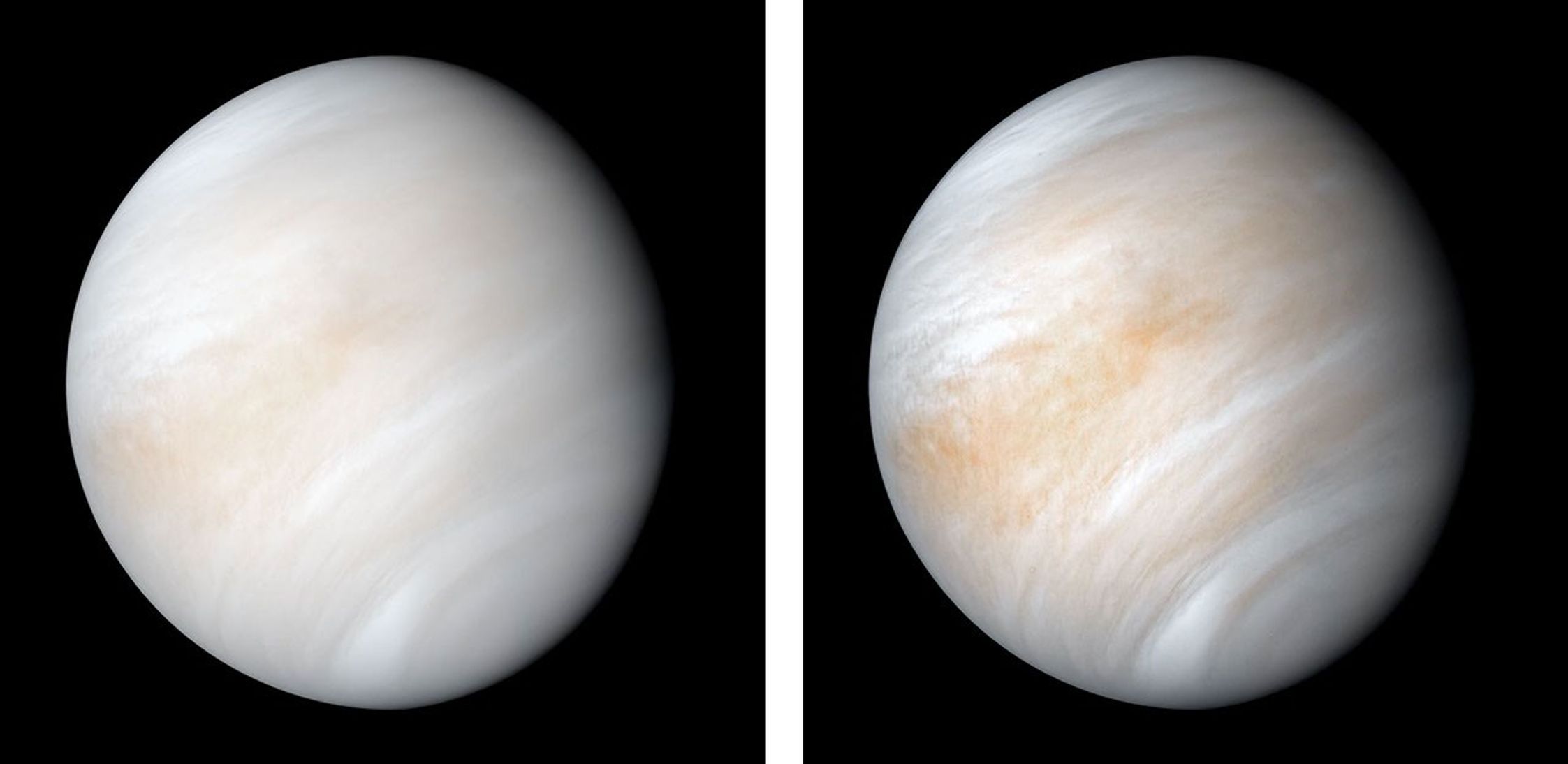
Venus: Mariner 10, February 1974. False-color composite. NASA/JPL-Caltech; processing by Kevin M. Gill. Image cropped for layout. Diagram: One Cosmic Thing. Image source